
Email:
[email protected]


This 12-day Morocco and Egypt tour pairs Egypt's Nile Valley monuments with Morocco's imperial cities on a single planned route. The Egypt leg covers Cairo, Aswan, and Luxor, including three nights aboard a 5-star Nile cruise between Aswan and Luxor and a full-day excursion to Abu Simbel. From Cairo, the trip continues to Casablanca, Rabat, Meknes, Fez, and Marrakech, tracing Morocco's Almohad, Marinid, and Alaouite history through mosques, palaces, and medinas. Private Egyptologist guides lead the Egypt sections, and local specialists take over once the group reaches Morocco, with domestic flights, a Nile cruise cabin, and hotel stays arranged throughout.
A representative meets travelers at Cairo International Airport to handle arrival formalities, then a guide arranges a private, air-conditioned transfer to a Cairo hotel for check-in. In the evening, a Nile dinner cruise features an open buffet and live entertainment, including traditional dervish performances, before a private transfer back to the hotel.
After breakfast, a private guide leads a tour of the Giza Pyramids Complex, a site that has stood for more than 4,000 years and includes three main pyramids, six smaller pyramids, the Great Sphinx, and the Valley Temple. The Great Pyramid, commissioned by King Khufu, remains one of the Seven Wonders of the Ancient World, while the Sphinx, built under Khafre, carries his likeness on a lion's body. The Valley Temple preserves evidence of the purification and mummification rituals performed for Egypt's kings. From there, the Grand Egyptian Museum spans nearly 490,000 square meters and holds artifacts covering more than 5,000 years of history, including the Hanging Obelisk, an 11-meter colossus of Ramses II, and the full Tutankhamun collection of more than 5,000 pieces. After lunch at a restaurant with pyramid or Nile views, the tour continues to Saqqara, where the Step Pyramid, built for Pharaoh Djoser by the architect Imhotep between 2670 and 2650 BC, stands as the world's first large-scale stone structure. A flight in the evening takes the group to Aswan for the overnight stay.
After breakfast, the tour visits the Aswan High Dam, built with UNESCO support to protect Egypt's monuments from Nile flooding and now a major source of power for the country. The Unfinished Obelisk, the largest obelisk ever attempted in ancient Egypt, remains in its original quarry after a crack halted its construction under Queen Hatshepsut. Philae Temple, relocated to Agilkia Island after the High Dam's construction, served as the principal center of worship for the goddess Isis during the Ptolemaic period.
After breakfast on board, a private guide leads a full excursion to Abu Simbel. The temple complex was carved into the cliffs around 1200 BC under Ramses II to honor the gods Amun, Ptah, and Re-Harakhty, and to commemorate his victory at the Battle of Kadesh. The Great Temple is known for its Sun Festival, held each year on February 22 and October 22, when sunlight reaches the sanctuary to illuminate the statues inside. Beside it, the second temple honors Queen Nefertari.
After breakfast on the cruise, a guided visit covers Kom Ombo Temple, a double temple with twin halls dedicated to Haroeris and Sobek, known for reliefs that reflect ancient Egyptian knowledge of medicine, art, and astronomy. Edfu Temple, dedicated to Horus and built between 237 and 57 BC, ranks among the largest and best-preserved temples in Egypt, with walls that narrate the mythological battle between Horus and Set.
After breakfast and check-out, the tour visits Karnak Temple, the largest and oldest religious complex in Egypt, built over nearly two millennia across 247 acres and dedicated mainly to the Theban Triad of Amun, Mut, and Khonsu; highlights include the Great Hypostyle Hall and the Avenue of Sphinxes. The Valley of the Kings, used for roughly 500 years during the New Kingdom, holds 63 royal tombs, including those of Ramses the Great, Hatshepsut, Seti I, and Tutankhamun. After lunch, the group visits Hatshepsut Temple, built in 1479 BC and dedicated to Amun, followed by the Colossi of Memnon, two statues of Amenhotep III carved around 1350 BC. A flight returns the group to Cairo for the overnight stay.
After breakfast and check-out, a private transfer takes travelers to Cairo International Airport for the flight to Casablanca. At Mohammed V International Airport, a local team welcomes the group with a name sign, assists with arrival and visa formalities, and arranges a private transfer to a Casablanca hotel.
After breakfast, a private guide begins at Hassan II Mosque, completed in 1993 above the Atlantic Ocean and designed by Michel Pinseau; its 210-meter minaret is the tallest of any mosque in the world. A panoramic tour follows along the Corniche and Ain Diab, through the Quartier Habous and Old Medina, taking in Rick's Café, Mohammed V Square, the Sacred Heart Cathedral, and the Central Market. The group then travels by private vehicle to Rabat, where Hassan Tower stands as a 44-meter unfinished minaret commissioned in the 12th century by Caliph Abu Yusuf Yaqub al-Mansur. Nearby, the Mausoleum of Mohammed V, completed in 1971 and designed by Cong Vo Toan, holds the tombs of Mohammed V, Hassan II, and Prince Abdallah. After lunch in Casablanca, the tour continues to the Kasbah of the Udayas, entered through the late 12th-century Bab Oudaia gate, and the Royal Palace of Rabat, known as Dar al-Makhzen and built in 1864 as the monarchy's working residence.
After breakfast, the tour heads to Meknes, one of Morocco's four Imperial cities and a center of centralized rule since the 17th century. Bab Mansour, completed in 1732, is decorated with green and white zellij tiles and marble columns taken from Volubilis, and was designed to project imperial authority. The Mausoleum of Moulay Ismail, one of the few religious sites in Morocco open to non-Muslim visitors, holds the tomb of Sultan Moulay Ismail within finely decorated prayer halls. Heri es-Souani and the Royal Stables once stored grain and sheltered up to 12,000 horses, while Place el-Hedim serves as the city's main square, and the Dar Jamai Museum displays Moroccan woodwork, ceramics, textiles, and jewelry in a 19th-century palace. After lunch in Meknes, the group visits Volubilis, the former administrative capital of Roman Mauretania Tingitana, which flourished between the 1st and 3rd centuries AD on olive oil production and trade with Rome. Its ruins include Roman mosaics depicting Hercules, Orpheus, and Venus, a 3rd-century Basilica, the Triumphal Arch of Caracalla built in 211 AD, and the Capitoline Temple dedicated to Jupiter, Juno, and Minerva.
After breakfast, a private guide leads a tour of Fez, beginning with Al-Qarawiyyin University, founded in 859 AD by Fatima al-Fihri and recognized as the oldest continuously operating university in the world. Bou Inania Madrasa, a 14th-century monument that also served as a mosque, features carved cedar wood and elaborate muqarnas ceilings from the Marinid era. After lunch, the tour continues to the Chouara Tanneries, which have operated since medieval times using natural dyes such as saffron and indigo, and the Nejjarine Fountain, an 18th-century structure decorated with floral zellij tiles beside a former caravanserai. The day closes with a walk through Fes el-Bali, a medina of more than 9,000 narrow alleys and the largest car-free urban area in the world.
A private transfer takes travelers from Fez to Marrakech, with scenic stops along the route. On arrival, guests check in to their hotel in the Red City for a restful overnight stay.
After breakfast, a guide leads a tour of Marrakech starting at Bahia Palace, a 19th-century residence with courtyards, gardens, and rooms decorated in carved cedar, zellij tilework, and stucco. Koutoubia Mosque, built in 1147 by the Almohad caliph Abd al-Mu'min, anchors the city skyline with its minaret; the interior is reserved for worshippers, but its gardens remain open to visitors. After lunch, the tour continues into the Medina and Souks of Marrakech, a UNESCO World Heritage Site where artisans work leather, metal, textiles, lanterns, spices, and perfumes, and to Jemaa el-Fna, which fills with food stalls, musicians, and storytellers as evening approaches. Travelers then transfer to Marrakech Menara Airport for their flight home.
A 25% deposit is required to lock in your booking. During busy festive periods (Christmas, New Year, and Easter), a 50% deposit is needed. The remaining balance can be paid before departure or settled in cash upon arrival.
Credit card payments require a signed authorization letter. The signature must match the one on your credit card and passport for security reasons.
Approved refunds are returned quickly to the original payment method. No-show bookings are non-refundable. A standard 6% bank processing fee is deducted from all refunds.
All rates are calculated on a double-occupancy basis. Solo travelers pay a single supplement. Properties are carefully chosen for comfort, quality, and safety. Prices may change according to market conditions.
Domestic flight schedules and fares are approximate and subject to airline changes. International flights are not included unless specifically mentioned.
We work hard to deliver a smooth experience. However, situations outside our control — such as weather disruptions, political events, or airline schedule changes — are not our responsibility. We will always try to limit any impact on your trip.
Tips are entirely optional and left to your personal choice. We never pressure guests to leave gratuities.
Please speak to your guide right away if any issue arises. Our Customer Care Manager remains available throughout your stay. Written complaints submitted after the tour are handled promptly by our Customer Care team.
Airline fees and a 6% bank charge apply to every refund.
If a government or airline issues an official travel restriction, you will receive either a full refund or a travel credit for future use. Only airline fees and bank charges will be retained.
Airline supplements for children may apply according to carrier policy.

This Morocco Egypt Tour connects two North African destinations in a single 8-day itinerary, opening in Cairo before continuing to Casablanca, Rabat, and Marrakech. Among Egypt Morocco Tours, this route stands out for combining the Giza pyramids complex, the Grand Egyptian Museum, and the Cairo Citadel with Morocco's Hassan II Mosque, the Kasbah of the Udayas, and the Medina of Marrakech. Private air-conditioned transportation, hotel accommodation, and English-speaking guides are included throughout, along with international airfare between Cairo and Casablanca.
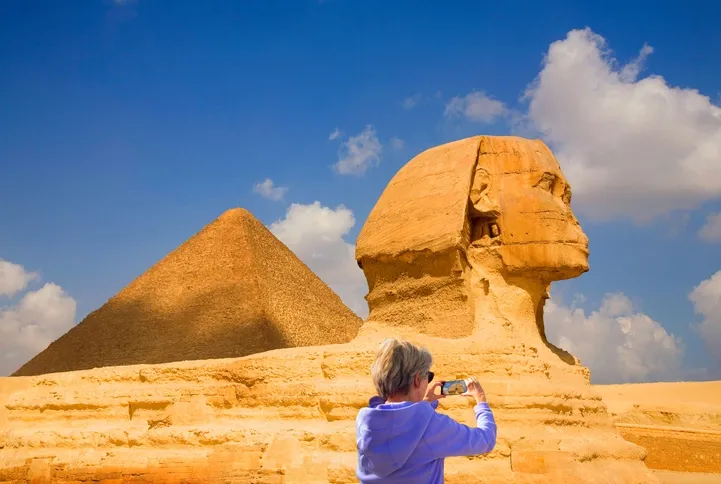
This 9-day Egypt and Morocco trip connects two regions with very different histories in a single itinerary, moving from the pyramids and temples of the Nile Valley to the palaces and medinas of Morocco's imperial cities. Travelers cover Giza, Cairo, Luxor, and Aswan in Egypt, then continue to Casablanca, Rabat, and Marrakech. The route is built around private guiding, domestic flights between Cairo and Upper Egypt, a train connection between Aswan and Luxor, and hotel stays arranged in each city along the way. Egyptologists lead the Egypt portion of the trip, and local specialists take over once the group reaches Morocco, so each region is explained by someone who works in it regularly.
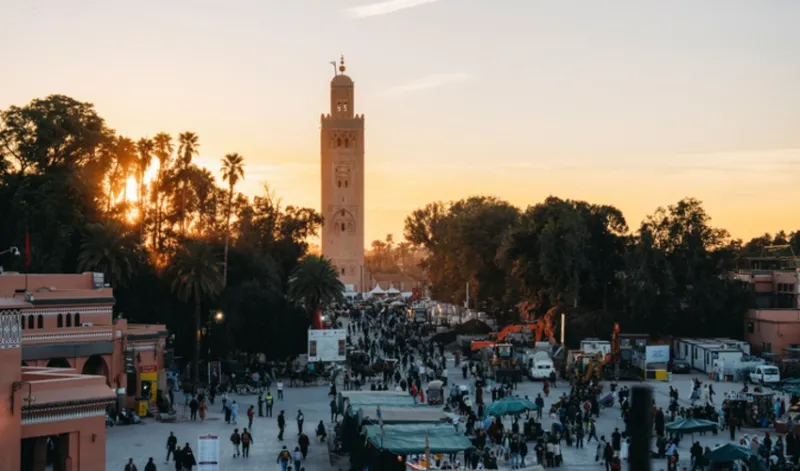
Have the chance to enjoy the best cities of Egypt and Morocco on one of our most comprehensive Egypt and Morocco tour packages. Start your trip immersed in ancient life by visiting Cairo, then take a Nile cruise to explore Luxor and Aswan. From there, fly to Morocco to enjoy four of its most iconic cities: Casablanca, Rabat, Fez, and Marrakech.
These Egypt Morocco tours are designed for travelers who want to experience two of the world's richest cultures in a single, well-organized trip, combining Morocco's imperial cities and desert-edged medinas with Egypt's pyramids, temples, and a luxury Nile cruise.
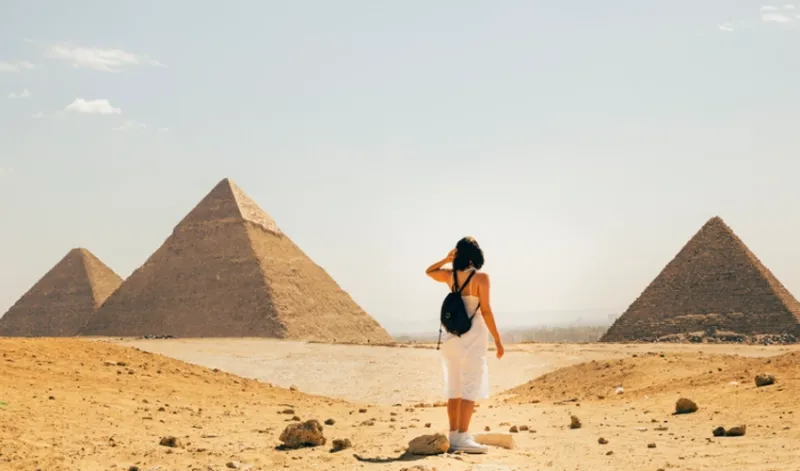
This Egypt Morocco Tour spans 13 days across two countries, opening in Cairo before continuing to a Nile cruise through Luxor and Aswan, then flying on to Casablanca, Rabat, Meknes, Volubilis, Fez, and Marrakech. Among Egypt Morocco Tours, this itinerary stands out for combining a 4-night Nile cruise with Morocco's imperial cities, taking in the Giza Pyramids, the Grand Egyptian Museum, Karnak Temple, Philae Temple, the Hassan II Mosque, and the Medina of Fez along the way. Hotel accommodation, domestic and inter-country flights, private transfers, and professional guides are included throughout both countries.
“Our 5-day Luxor to Aswan Nile cruise on the Movenpick Royal Lotus was absolutely magical. The ship was elegant, the food excellent, and our Egyptologist guide made every temple visit come alive. The sunset views from the deck were breathtaking. Highly recommended for anyone wanting a luxury Egypt experience!”

“I traveled solo and felt completely safe and pampered. The Acamar Nile Cruise was beautiful and comfortable. The temples were even more impressive than I imagined, especially Karnak at sunrise. The crew was attentive and the food was delicious. This Nile cruise tour exceeded all my expectations.”

“We celebrated our 30th anniversary on the Le Fayan Nile Cruise and it was perfect. The ship felt like a floating boutique hotel. The Valley of the Kings at sunrise was emotional and unforgettable. Excellent service and wonderful memories created. We can't wait to return!”

“Abu Simbel is one of the best monuments I've ever seen in my life. The scale and beauty are unbelievable. Our guide was fantastic. This is a must-do on any Egypt itinerary.”

“Aswan was our favorite part — so peaceful and romantic. The Philae Temple at sunset and the Nubian Villages were magical. The Nile cruise from Luxor to Aswan was the perfect combination.”

“We celebrated New Year on a Nile cruise and it was spectacular! The gala dinner, fireworks over the Nile, and the ancient temples made it truly special. Best New Year’s Eve of our lives.”

The best time is between October and April. The weather is cool and pleasant for visiting temples in Luxor and Aswan. Summer (June to August) can be very hot, with temperatures exceeding 40°C.
The drive takes approximately 2.5 to 3 hours each way via the Desert Road, covering about 220 km (136 miles).
We usually stop at a local restaurant overlooking the Mediterranean. You can enjoy fresh seafood, but please check your booking 'Inclusions' to see if lunch is prepaid or optional.
Yes, we visit the outer plaza and can arrange for an internal tour during opening hours (closed on Fridays and Saturdays in some sections). Your guide will provide all the historical context.

We specialize in delivering high-quality Egypt packages designed to provide exceptional value, comfort, and unforgettable experiences. Our Egypt packages are carefully planned to meet the expectations of modern travelers seeking a seamless journey.
Every Egypt package is fully customized to match your travel style, interests, and expectations, ensuring a truly personalized experience
Our local team brings deep knowledge and expertise to every Egypt tour, offering authentic insights and smooth on-ground support.
Enjoy premium Egypt travel packages at competitive prices with full transparency and no hidden costs.
From booking your Egypt packages to completing your journey, our team is available around the clock to assist you.
We carefully select the best destinations, hotels, and activities to create high-quality Egypt tours and unforgettable travel experiences.
Our Egypt packages are trusted by travelers worldwide who seek reliable service and memorable journeys across Egypt